If - like me - you thought E-waste was something to do with an overflowing waste bin in your email program, think again! It is in fact a quick way to say electronic waste.
Showing posts with label EARTH'S GARDEN. Show all posts
Showing posts with label EARTH'S GARDEN. Show all posts
23 Nov 2010
What is E-waste?


12 Sept 2010
A Time for Everything

In the garden, there is a specific time for everything: for planting, for harvesting, for pruning, for fertilizing...And if you follow the biodynamic system and adjust your practices according to the moon, then these times are further subdivided into planting times for root vegetables as opposed to those that grow above ground, for trees that fruit as opposed to those that don't, etc etc.
An awareness of these natural cycles is something that we have grown further and further away from as we have changed to living in cities with 24 hour a day electric light and artificial heating and cooling systems and yet we continue to be governed by these ancient patterns although we are not always consciously aware of it.
Read More......
6 Aug 2010
Retro Britain - nostalgia for bygone days

Visiting the UK recently, I was struck by a mood of nostalgia that seemed to be present everywhere. Strings of bunting were to be found everywhere — from people's back gardens to community allotments as well as decorating the 'Big Lunch' street-parties that took place all over the UK on July 18th.

Traditional British beach holidays have made an incredible comeback — complete with stripy deckchairs and Punch and Judy shows for the kids. People are paying whopping sums to own a beach hut such as the one in the photo for sale in Whitstable from £12,000 and many families are going the full hog and shifting out of the bigger cities to take up permanent residence in the once-deserted but now highly-priced and highly-prized coastal towns.

Read More......
28 Oct 2009
Green Politics can be FUN!

At last, Green Politics gets a sense of humour. Check out the new campaign from Greenpeace to send virtual packages to Copenhagen to demand action on climate change.
I've sent mine, why not send one too?

15 Oct 2009
Drilling too Deep?
Supporting Today's Blog Action Day for Climate Change

These days, however, technological advancements along with the relative increase in affluence in the country mean that more and more people – both farmers and the owners of rural (often second) homes - are digging (legally or illegally) deeper and deeper into the earth's core for their water sources. This has been exacerbated by the property boom during which unscrupulous speculators took advantage of a loop-hole in the law which allowed houses to be erected on smaller plots of land provided they were on 'riego' – or irrigated – land and not 'secano' – traditional, unirrigated farmland usually used for olive, almond and cherry trees.
Reading today in El País about the underground fires in the Natural Park of Las Tablas de Damiel in the province of Castilla Mancha which have been burning since August, it is clear that there are long-term environmental consequences to draining our ground-waters and that those consequences are serious.
 Las Tablas de Damiel are 'humedales' – or wetlands – and, as such, the last place you would expect this kind of fire to occur. The fires are started by the spontaneous combustion of 'turba' – or peat – formed during 300.000 years in an oxygen-free environment. Four years of drought have dried out the land to such an extent that cracks have appeared in the surface creating an air flow underground that, when combined with an increase in temperature, cause the peat to self-ignite.
So what does all this have to do with deep drilling for water? Well, surprise, surprise, it turns out that, as well as the effect of the four years of drought, it is the thousands and thousands of illegal wells in the region that have substantially contributed to the dryness of the ground in the natural park by depleting the groundwater to this dangerous level. 15 hectometers (about the equivalent of 15 football stadiums) of water are now needed to flood the area sufficiently to put out the fires.
Miguel Ángel Soto, responsible for Greenpeace's Forest Campaign, warns that when we talk about the effect of greenhouse gas emissions, we have to consider not only emissions from things like factories but also the abuse of the wetlands which are changing from absorbing CO2 to emitting it instead. The fire in Las Tablas de Damiel is emitting each day approximately 100 to 400 tons of CO2 and carbon monoxide as well as methane, another greenhouse gas. And this fire isn't an isolated incident: In the US, last year, a peat fire in the Pocosin Lakes National Wildlife Refuge in South Carolina burned for three months destroying 17.000 hectares of land and in Australia a similar fire has been raging for centuries!
So it turns out that the fires in Las Tablas de Damiel are a double whammy when it comes to climate change. Not only are we losing the beneficial process of CO2 absorption that the area would normally perform but greenhouse gases are being increased by the fires raging there. And the presence of this fire is directly related to the abuse of our groundwater resources.
Photos from El Pais article: Trasvase de emergencia contra el incendio subterráneo de Daimiel and US Fish and Wildlife Service News Release Evans Road Fire on Pocosin Lakes National Wildlife Refuge Officially Declared "Out" Read More......
9 Oct 2009
4 Oct 2009
What If?
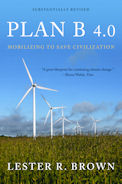
What if instead of impending scenarios of food shortages in developed countries and starvation in the developing ones, we could feasibly achieve an acceptable worldwide balance between food and people?
What if we could drastically reduce the levels of heart disease, cancer and obesity in the West and effectively control infectious diseases in developing countries at the same time as substantially reducing child mortality?
And what if we could do all this by 2020?
Lester R. Brown - President of the Earth Policy Institute - believes that not only can we do all this but much, much more and we do it by 2020 if we begin now.
In his book, Plan B 4.0: Mobilizing to Save Civilization (available in hard copy or as a free PDF download), Lester outlines his road map for achieving an environmentally sustainable economy by investing in energy and water efficiency, using existing harvests more productively at the same time as stabilizing population and ensuring basic health care for people in low-income countries. According to Lester, none of these initiatives depends on new technologies. We know what needs to be done and all that is we need now is leadership.
But what if, its not just leadership we need but a groundswell of opinion? What if its not just up to 'them up there' but us down here? What if its about me, you and Joe Bloggs over the road standing up, taking action and being heard?
What if we can just start tomorrow? Or today?
Read Plan B 4.0: Mobilizing to Save Civilization and What You Can Do and lets get on with it!
Read More......
16 Nov 2008
Join the Largest Movement in the World
 I'm trying desperately to find the time to explore more of what's going on at one of my favourite sites, WiserEarth because every time I visit, I find myself so stimulated by the broad range of discussions and information on offer that I end up bookmarking more things to revisit than I can ever hope to catch up with in a lifetime.
WiserEarth - according to the site itself - is "an online community space for NGOs (non-governmental organizations) and those that support their work: businesses, government agencies, funders, social entrepreneurs, students, organizers, academics, activists, scientists, and other concerned citizens of the world. (i.e. everybody - ed). WiserEarth provides the tools to help these 'communities of action' find each other, make connections, share resources, and build alliances." The vision for a WiserEarth originally came from environmentalist, entrepreneur, journalist, and best-selling author, Paul Hawken who is the author and co-author of dozens of articles and papers, as well as six books including Growing a Business, Blessed Unrest: How the Largest Movement in the World Came into Being, and Why No One Saw It Coming and The Ecology of Commerce. In The Ecology of Commerce he introduced the 'comprehensive outcome principle' - taking account of the entire result of an event or process to all parties, not just the immediate participants - which was to be extremely influential in the eventual emergence of the concept of the ecological footprint and triple bottom line standards for sustainability.
Since then he has dedicated his life to changing the relationship between business and the environment, and between human and living systems in order to create a more just and sustainable world. His work includes starting and running ecological businesses, writing and teaching about the impact of commerce upon the environment, and consulting with governments and corporations on economic development, industrial ecology, and environmental policy.
One of the things that makes WiserEarth so unique is that it functions both like Wikipedia, where any registered user can create and edit content, as well as like FaceBook where you can use social networking tools to connect with others. Because of this interesting mix of approaches, there is a lot of really fascinating content to be read and discussions to take part in for anyone interested in environmental and social change.
It was WiserEarth that first led me to define WhatWeGrow as an 'Ecopsychology' site, as I had never heard the term before, and one of the areas that fascinates me most is the stimulating discussions going on about the relationship that exists between our minds and bodies and the environment and societies within which we live and the connections that exist between these and cultural and educational practices. If this sounds like your cup of tea, integralecoawareness.org are offering a three day course in Berlin in December which promises to 'open pathways to empower the individual to creatively engage in change' through a very broad range of methodologies ranging from somatics/bodywork, to permaculture and nature awareness. Unfortunately I won't be able to make this one but I'm looking forward to feedback on how it goes :-)
Paul Hawken credits a Native-American for teaching him that the division between ecology and human rights is an artificial one, that the environmental and social justice movements addressed two sides of a larger dilemma; that the way we harm the earth affects all people, and how we treat each other is how we treat the earth. If you want to find out more about Paul Hawken, about ecopsychology or about the largest movement in the world, why not join me over at WiserEarth?
Sources: WiserEarth, Wikipedia and Integral Eco Awareness.org
18 Oct 2008
The Seeds of Economic Panic
 Watching the news and reading the papers and seeing the panic seeding and growing worldwide produces an odd sensation in me. Firstly, I can't help feeling that the more we shout, 'Recession is Coming', the more likely it is to come or is that obvious only to me? Put it this way: If someone keeps telling me that a plant I had hitherto believed to be perfectly healthy, is in fact suffering from over-watering what is my most likely reaction? To stop watering the plant...and then there is every possibility that my plant will die of thirst! Every alarmist headline we read decreases our confidence both in our economic institutions and our governments. This makes us more likely to, firstly, reduce our spending causing the business we normally patronise to have reduced profits and lay people off which in turn causes increased unemployment, even less spending etc. Secondly, we withdraw our savings to dig a hole in our back garden in which to hide them - this location very suddenly seeming like a far safer location than our local high street bank branch - which in turn reduces the cash flow available to the banks and makes them more likely to go bust...
Surely we are caught up in some sort of chicken and egg syndrome here? What would happen to the world's economies tomorrow, I wonder, if newspapers worldwide printed, "Likelihood of Recession Recedes as Businesses Boom Again"...?
The other thing that strikes me is the obsession we all have with economic growth. Surely it is impossible that there is continual growth? You don't have to spend looking at anything in nature before you realise that nothing, but nothing grows infinitely...Even the tallest Redwood one day keels over with its roots in the air. Cycles of growth and die back are unavoidable, otherwise the world would be stagnant. It seems to me that we need to adjust our economic systems to accommodate this or we will be perpetually perplexed when the growth patterns of our economies suddenly go into 'inexplicable' decline. We need to accept that there will be times of die back and learn to exploit them as times to reflect on where we have been going, where we might want to go in the future and consider what new, innovative ways we could use to go there.
A plant may die because it has reached the end of its natural life-span or because it has been attacked by a disease or parasite that it is not strong enough to resist. Either way there are lessons to be learned. Perhaps now is the time we ought to start looking at our economic systems with these lessons in mind?
17 Oct 2008
Perhaps poverty is more common than we think
Maria Pacheco from Guatemala is an organic farmer, social entrepreneur and an accomplished champion of indigenous rural women’s empowerment. In 2004, Maria founded Kiej de los Bosques (Protectors of the Forests) to create eco-friendly economic opportunities for indigenous women. Today, Kiej de los Bosques provides 300 rural women’s associations with invaluable technical assistance focused on small business development and environmental sustainability.
One of my favourite short film-makers, Nik Askew, has made a wonderful short film about Maria and the lessons she has learnt both about poverty and about herself from her work with poor communities in Latin America.
5 Oct 2008

Apparently Queen Elizabeth is planning to build, at her own expense*, an absolutely enormous wind turbine - apparently equivalent in size to over 600 corgis standing on each other's backs...Perhaps Charlie has finally managed to turn his Mum green?
Head over to Eco Geek to get the full story.
*If you discount the fact that her money is levied in taxes from her subjects, that is...Ed. Read More......
20 Sept 2008
THE POND - part 1: Reflections

The pond is where we go narcissistically looking for a reflection of ourselves, trying to discover who we are; But unlike the cold looking glass, In the Pond we cannot help but see ourselves in context - not isolated beings but part and parcel of that also-reflected world around us and the hidden universe in the depths below us; the perfection of our image broken by the ever-changing, ever-moving, imperfect world behind our heads and the mysteries of the depths in which the fish swim below us.
THE POND - part 2: A Mirror To Yourself
Will you do something to leave a positive mark on the world?
This is not about giving things up. It's just about giving and taking action. Neither is it about asking other people to do something - like politicians - it's all about doing it ourselves. This is about having a positive "handprint”" to reverse the ecological damage happening around the world. Restore the Earth.org are asking us to sign up to the vision to Restore the Earth and to do something to leave a positive handprint in the global community. The 1st goal is to sign up 1 million handprints who act positively for the Earth. Please take a moment to sign up.
22 Aug 2008
Why Plant Trees?

Did you know that one large tree produces the cooling effect of 10 room-size air conditioners? And if you did, do you know why? The latest podcast from What We Grow.com explains all the benefits to be had from the planting of a humble tree.
You can download the full transcript for this podcast here.
If you prefer you can download the MP4 version here.
Music for this podcast is from the album Manos Unidos by Santiago Louvet. It is distributed under a Creative Commons License and available from www.jamendo.com
For a fuller discussion of this topic please visit www.coloradotrees.org and www.mongabay.com
Subscribe to What We Grow podcasts: in iTunes Miro BlipTV Read More......
6 Aug 2008
Forest Love
Come together for forests:
The European Commission has delayed a vital vote on protecting forests from illegal logging till September. Make sure the commissioners don't forget about it during their summer holiday. Show your passion amongst the trees and help Greenpeace make an extra impression before the September vote. After all, its summer so what better time to get out amongst the cool green of your nearest forest? And you'll also have the chance to be in a Greenpeace video.
So come on, make love to a forest this summer!
Click here for more info.
1 Aug 2008
Your turn to run the country!
 Do you find yourself sighing over the decisions of politicians when it comes to climate change policy? Surely the answers are more than obvious?
Unfortunately, introducing policy changes is not just a matter of deciding to do it. As a politician you have to take into account the popularity of your measures with the electorate and seek support from other countries across the world. Think you could do it? Try out the BBC's Climate Challenge game and see if you can manage to reduce CO2 emissions and set a few other of the world's problems to rights at the same time!
11 Jul 2008
Why Shop Local?

This week on What We Grow we ask "Why Shop Local?".
You can download the full transcript for this podcast here.
If you have problems playing this version, try the MP3 version here.
Music for this podcast is from the album Manos Unidos by Santiago Louvet. It is distributed under Creative Commons License and available from www.jamendo.com
Read More......
You can download the full transcript for this podcast here.
If you have problems playing this version, try the MP3 version here.
Music for this podcast is from the album Manos Unidos by Santiago Louvet. It is distributed under Creative Commons License and available from www.jamendo.com
9 Jul 2008
Tree of Heaven

The first in our new series of podcasts
This week we talk about the Tree of Heaven and try to decide if it is a pioneering shade tree or simply a noxious weed.
17 Jun 2008
Getting Down To The Roots of Climate Change
Brazilians will have to plant trees to get married, get divorced or buy cars! Brazil is taking the We Are What We Grow idea to its logical conclusion with a new law that will mean, if passed, that all Brazilians must plant trees when they get married or divorced, buy a car or construct a new house.
The law, which is currently going through parliament, proposes that every Brazilian plant ten trees to get married and 25 to get divorced.  If it is approved, just the purchase of cars would mean the planting of 60 million trees a year with a 'tax' of 20 trees for a light vehicle rising to 60 for a heavy one.
The construction industry would be likewise taxed with the law demanding 10 trees for every residential unit and 20 for a commercial one. This would mean another 65 thousand trees a year. The law, which is proposed by the Democratic Labour Party also suggests that a tree should be planted for every baby born in the country.
Here's hoping that the law gets through parliament and that countries world-wide start adopting similar sensible approaches to dealing with the earth's deforestation problem.
9 Jun 2008
The Breadcrumb Trail
 A year or so ago we bought one of those bread boards that has wooden slats and a tray underneath to catch the breadcrumbs when you cut the bread. I had always thought of it as a mess-saving contraption which stops the crumbs scattering in all directions over the work-surface but the other day it occurred to me (ok, I'm slow!) that what I was looking at was, in actual fact, the original bread-recyling device.
In other words, the real intention of this breadcrumb-catching tray was to capture the breadcrumbs in order to save them for later use as...well...breadcrumbs. It got me thinking that, indeed, I could amass quite a large amount of breadcrumbs that way, supplementing the bags of stale bread we normally save for the purpose of those recipes that require dipping in breadcrumbs or thickening with them. (Spain has quite a large number of breadcrumb-based recipes, not least the infamous 'migas' which are fried breadcrumbs usually mixed with sardines. See below for details of how to make them in our new series of Leftover Bread recipes.)
I must admit I've always wondered at the bags of breadcrumbs for sale in supermarkets. It seems to me such an odd thing to buy. I try to imagine the type of person who doesn't have a bit of stale bread that they can turn into breadcrumbs when they need to. Or alternatively, someone with such a vast consumption of breadcrumbs that the stale bread they do have goes nowhere near satiating their demand for breadcrumb production. The inevitable conclusion is that in fact those people do have stale bread - and enough of it to satisfy their dipping and thickening needs - but they simply lob it into the bin and when they need breadcrumbs, they go and buy them in a packet. The mental connection between the bread and the crumbs is lost to them.
Once again, all this seems to lead back to the divorce in our society between production and consumption as well as - given that according to a recent survey, one third of all food bought in the UK is thrown away - to the unprecedented affluence in which many of us are living. In the days when we baked our own bread, it was a valuable commodity achieved by our own sweat and hard work and so every last morsel was precious and saving the crumbs was an obvious thing to do. Likewise the intrinsic worth of bread was very high for not only was it a staple food but one which many could barely afford and hence whose crumbs were not to be wasted. Now, with 'bread' being just one more thing written on our supermarket list, it doesn't seem that odd to add 'packet of breadcrumbs' as well.
You can read the details of what a previous government exhorted us to do about this issue by clicking on the image above.
For a more contemporary view go to: LoveFoodHateWaste.com
And to tickle your tastebuds further: Migas: The first in our new series of Leftover Bread Recipes!
Subscribe to:
Posts (Atom)

 Posts